|
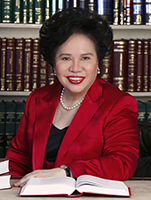
Senator Miriam Defensor Santiago
Senate Office:
Rm. 521-A 5th Flr., GSIS Bldg., Financial Center, Roxas Blvd., Pasay City
Trunk Lines: (632) 552-6601 to 70 loc. 5562 / 5590
Direct Lines: (632) 552-6692-93
Telefax No.: (632) 552-6692
Email: miriam@miriam.com.ph,
senmds@yahoo.com,
mdsmediabureau@yahoo.com
Website:www.miriam.com.ph
Quezon City Office (Main Office):
4/F Narsan Bldg., 3 West Fourth St., West Triangle, 1104 Quezon City
Direct Lines: (632) 411-4380 / (632) 371-9156 / (632)372-4573
Telefax No.: (632) 374-3059
|
Biography |
Agenda
Asian Nobel Prize Laureate
Miriam Defensor Santiago became globally famous with her
courageous and brilliant crusade against corruption in the
Philippines. As a result, at 43, she was named Laureate of the Asian
Nobel Prize, known as the Ramon Magsaysay Award for Government
Service. She was cited "for bold and moral leadership in cleaning up
a graft-ridden government agency."
Miriam was widely featured in the international press because of her
charisma, flamboyant personality, and her signature witticisms,
making her good copy. In 1997, the Australian magazine named her one
of "The 100 Most Powerful Women in the World." In later years,
Miriam was keynote speaker of the international anticorruption
conference in Sydney, Australia. As senator, she sponsored and
secured ratification by the Philippine Senate of the UN Convention
Against Corruption.
Miriam ran for President of the Philippines in 1992, and led in the
canvass of nationwide votes for the first five days. But she was
ultimately defeated by a margin of less than a million votes out of
36 million votes. The campaign was reportedly marred by widespread
election fraud, notably power blackouts after the first five days.
The public outrage over the presidential results prompted Newsweek
to feature her and her rival on the cover with the question: "Was
the Election Fair?" In another cover story, Philippine Free Press
magazine asked: "Who's the Real President?"
Child Prodigy
Miriam was born in 1945 in Iloilo City, in southern Philippines.
Her father Benjamin was a district trial judge, and her mother
Dimpna was a college dean. She is the eldest of seven children, most
of whom she helped to send through college.
Miriam graduated valedictorian of the La Paz Elementary School, and
valedictorian of the Iloilo Provincial National High School, also
earning a medal for all-around excellence. In high school, she
proved to be a child prodigy. As a freshman, she won as champion of
a Spelling Bee which included seniors. Also still a freshman, she
topped written examinations and was appointed by a faculty panel as
editor-in-chief of the high school paper, a post which she held for
four years. She was high school swimming champion for the entire
province during competitions sponsored by the Red Cross. She topped
the National College Entrance Examinations for the Western Visayas
region.
Record-Setter at University of the Philippines Visayas
At 16, Miriam enrolled as freshman at the University of the
Philippines Visayas in Iloilo City. Repeating her high school
achievement as a freshman, she topped the written examinations and
was appointed editor-in-chief of the college paper, a post she also
held for four years. She emerged champion in oratorical and literary
contests. She even held a campus beauty title as UP ROTC corps
sponsor.
She finished the academic requirements in only three and a half
years, instead of four years. Nonetheless, she remained at the
university for an extra semester, which she finished with a near
perfect average grade of 1.1. (In the Philippines, 1.0 is the
perfect grade.) She graduated Bachelor of Arts in political science,
magna cum laude. She was also recipient of the Rotary Award for Most
Outstanding Graduate.
Record-Setter at University of the Philippines Diliman
Miriam then flew to Metro Manila to take up law at UP Diliman. As
a freshman in law school, she topped written examinations and was
appointed editor-in-chief of the law school paper. Eventually, she
was also appointed editor of the Philippine Law Journal. She was
only a freshman when she won campus-wide elections as councilor in
the University Student Council, where she eventually became
vice-chairperson.
Miriam is best remembered in the state university for breaking a
record of 50 years of male dominance, by topping the written
examinations and getting appointed as the first female
editor-in-chief of the nationally prominent student newspaper, the
Philippine Collegian. She also made history by posting the highest
number of consecutive college scholarships in the state university
(a college or university scholarship is equivalent to a place in the
Dean's List). Another record was that she became the only female to
be appointed twice to the campus beauty title of UP ROTC corps
sponsor. Another record was that she twice received the Vinzons
Achievement Award for excellence in student leadership. Another
record was that she became the first female to win as Best Debater
in the annual debate between UP Diliman and UP Manila law schools.
A faculty panel chose her as one of the U.P. Ten Outstanding Coeds.
A feature story in the Manila Chronicle magazine said it all, when
it described Miriam as "super girl at the state university."
Miriam graduated Bachelor of Laws, cum laude, from the state
university. She was valedictorian of her class at the UP Diliman
campus. (At that time, there was an evening law school for working
students at UP Manila).
Record-Setter at University of Michigan
After marriage, Miriam won the DeWitt Fellowship at the
University of Michigan law school. She finished her first semester
in graduate school with an A average. On the basis of her high
grades, for the first time in the law school's history, a graduate
student was allowed to pursue a special program. Thus, she earned
the degree Master of Laws after one year, and the degree Doctor of
the Science of Jurisprudence, after only six months. Her grades
qualified her for the prestigious Barbour Scholarship. Her doctoral
dissertation, with Prof. William W. Bishop, Jr. as supervisor, was
later published as Political Offences in International Law.
Lawyer and Theologian
Not content with her law doctorate, Miriam later pursued
postdoctoral studies in law at Oxford, Cambridge, Harvard, Stanford,
University of California, at Berkeley, and Southern Methodist
University in Dallas, Texas. She attended the Hague Academy of
Public International Law at The Hague, Netherlands, and at Sophia
University, Tokyo.
Already a senator, she finished with high grades the academic
requirements for the degree, Master of Arts in Religious Studies, at
the Maryhill School of Theology in Metro Manila. She wrote her
published master's dissertation, Christianity Versus Corruption,
Political Theology of the Third World as a Fellow at St. Hilda's
College, Oxford. Because her book was in part critical of the
Catholic hierarchy in the Philippines, she was asked to rewrite some
chapters, but she refused.
Public Service
At 25, Miriam was invited to join big Makati law firms. But she
chose government service, as special assistant to the Secretary of
Justice who, under Philippine law, is the official legal adviser of
the executive branch. Later, in the same position, she was tapped as
one of the speechwriters of President Ferdinand Marcos, a lawyer.
Not content with working full-time as a lawyer, Miriam also took on
a teaching post in the evening. She was professor of political
science in Trinity College, and eventually professor of law in UP
Diliman. She held down a third job as an opinion columnist for a
Sunday magazine and later in life, in a national daily.
Prolific Author
In her starting years as a lawyer, Miriam began to write law
books. She also wrote two autobiographies, Inventing Myself and
Cutting Edge: The Politics of Reform in the Philippines. She has
written some 30 textbooks in law and in the social sciences,
particularly political science and philosophy. In her Code Annotated
Series, she annotated the major codes of law in her country
(Constitution, Rules of Court, Civil Code, Penal Code, etc.) with
decisions of the Supreme Court. The Series, widely used in law
schools and in the judiciary, will undergo second editions in 2007.
Her books are listed in the US Library of Congress.
She is acknowledged by the media and fellow senators as an expert in
constitutional and international law.
United Nations Officer
When the Secretary of Justice was promoted to associate justice
of the Supreme Court, he requested that Miriam should be seconded to
the Supreme Court as his law clerk. For half a year, she researched
and drafted legal opinions.
She then flew to Geneva, Switzerland where she served as legal
officer of the United Nations High Commission for Refugees, assigned
to the treaties and conferences section. As a UN officer, she took
French classes. Her budding UN career was cut short, when her father
contracted terminal cancer, forcing her to resign. Serving as a
caregiver at his bedside, she accepted part-time work as legal
consultant of the UP Law Center.
After her father's death, she briefly worked as legal consultant to
the Philippine Embassy in Washington, D.C. But in 1993, during the
national judicial reorganization, she returned to Metro Manila to
take up a new post as Regional Trial Court judge of Quezon City.
Most Decorated Trial Judge
Miriam's appointment to the trial court in Metro Manila was
exceptional, because newcomers are usually appointed in the
provinces before they are considered qualified to sit in Metro
Manila trial courts. She soon proved her mettle, by decreeing that
she would not entertain any motions to postpone trial. Postponements
are the bane of the Philippine judiciary, thus delaying justice.
As a freshman judge, Miriam disposed of the highest number of cases
in Metro Manila. Her reputation for integrity, competence, and
efficiency became established, and she was showered with awards for
judicial excellence from civic groups, notably as one of the Ten
Outstanding Young Professionals of the Philippine Jaycees, and the
Ten Outstanding Women in the Nation's Service of the Philippine
Lions.
Her awards for judicial excellence, added to her awards for
anticorruption work as immigration commissioner, make Miriam the
most awarded Filipino public official today.
National Prominence
Miriam first rose to national prominence, when a case was raffled
to her court, involving an arrest warrant called Preventive
Detention Action issued during the martial law regime of President
Marcos. A group of university students, mostly from UP and Ateneo de
Manila University, accompanied by a group of the religious and of
film luminaries, staged a public assembly in Quezon City. They
protested not only an oil price hike, but also the alleged
extravagance of the First Lady. They were all promptly thrown in
jail, placing the students in danger of missing their final
examinations for that semester. The students sued for release, and
the case was raffled to Miriam.
At that time, judges were afraid to rule against any martial law
edict. The prosecution presented so many witnesses that it would
have been impossible to finish trial, before the week of the final
exams for the university students. But Miriam suspended her regular
calendar of trials, and proceeded to conduct marathon hearings on
the case.
Her eventual decision to release the students was hailed as a
courageous act that stressed judicial independence, even during a
martial law situation. She became a national heroine to all
university students, and earned the grudging respect even of the
martial law administrators.
International Prominence
After the first People Power revolution, President Marcos was
forced into exile and replaced by President Corazon Aquino, a former
housewife whose assassinated husband had been the leading opposition
leader during martial law. The new president plucked Miriam out of
the judiciary, and gave her the mission of cleaning up the
notoriously corrupt Commission on Immigration and Deportation.
Miriam rose to the challenge, and launched an anticorruption crusade
that took the Filipinos' breath away. Described as "a breath of
fresh air," she became an overnight sensation. She ordered lightning
raids on criminal syndicates that had made the Philippines notorious
as the fake passport capital of Asian. She filled the immigration
detention center to bursting with foreign criminals engaged in the
pedophile industry, smuggling of illegal aliens, including
prostitutes, import and export of illicit firearms and dangerous
drugs, and even operatives of the infamous Yakuza.
Almost every week, the media were full of Miriam's successful
exploits against criminal syndicates. At this point, she earned the
wrathful resentment of politicians who are patrons and benefactors
of certain criminal syndicates.
For her extraordinary success in the capture of fugitives from
justice, certain governments, such as the US, Australia, and Japan,
invited Miriam to their countries to share her expertise in the
enforcement of immigration law.
Darling of the Press
Miriam became the darling of the press, both national and
international. She was featured by TIME, The Economist, New York
Times, Washington Post, and International Herald Tribune, among
others. She graced dozens of magazine covers. They tried to capture
her colorful personality with such accolades as: the incorruptible
lady, the iron lady of Asia, the dragon lady, the platinum lady, and
the undisputed campus heroine. Her intense and passionate orations
against corruption captured the public imagination. On the
invitation of universities and civic groups, she began a hectic
nationwide speaking tour that would continue for at least one
decade.
At the height of her popularity, Miriam's charisma could cause
shopping malls to close down for the day, and could cause traffic to
snarl. On one weekend when she went shopping at a Quezon City mall,
she attracted such a huge throng of autograph seekers that virtually
the entire mall closed down, because store owners were afraid that
the crowd might turn into an uncontrollable mob. This was duly
reported in media.
On one holiday, when she went to the mountaintop resort of Baguio
City, the entire downtown traffic went into gridlock. The traffic
cop recognized her at the wheel of her car, and stopped traffic to
greet her. All other car owners and bus drivers then left their
vehicles to shake her hand, and traffic became so snarled that the
mobile patrol unit had to be called to restore order.
Her famous quips have been captured in the book Miriam Dictionary.
She once told media: "I eat death threats for breakfast." When a
congressman delivered a privilege speech against her for a lightning
group arrest of foreign pedophiles occupying a village in his
district, Miriam called him "fungus face." She was famous for
describing her anticorruption work as needing "the epidermis of a
pachyderm" and "intestinal fortitude." Filipinos were delighted
when, on TV, she told a foreigner charged with pedophilia: "Sir, I
represent the majesty of the Republic of the Philippines. Now shut
up, or I'll bash your teeth in!"
Finally, the ultimate recognition of her dangerous and backbreaking
work came. The Magsaysay Awards Foundation named her in 1988,
Laureate of the Asian Nobel Prize, known as the Magsaysay Award for
Government Service. Thus, she joined the elite of Asian heroes who
have dedicated their lives to public service.
One amusing postscript to Miriam's reign as "queen of popularity
polls" was the constant media mention of her acclaimed beautiful
legs. After she left the Cabinet, she gave a poolside interview to a
reporter of the Daily Inquirer, which featured Miriam seated by the
pool hugging her legs. This photo became the talk of the town, and
without her permission, was used by an enterprising group of young
Makati businessmen as a calendar photo.
Assassination Attempt
Miriam's popularity was so widespread among the youth, the
yuppies, and the poor that politicians begun to feel threatened. As
a result, she became the subject of character assassination and
black propaganda, manufactured out of sheer lies and fabrications by
highly paid public relations firms.
Because her millions of fans call her a genius, her political
enemies tried to peddle the desperate charge that she is eccentric.
Because her fans adore her charisma, her political enemies called
her intellectually arrogant. Because her fans call her a fighter,
her enemies dubbed her as a non-team player.
Her fans were so outraged at the political malice being thrown in
their idol's direction that they begin to agitate that Miriam should
run for president. At first, Miriam treated the subject as a joke.
But she began to top presidential surveys by all national survey
firms, as well as campus presidential surveys conducted by student
organizations all over the country.
When she became a real political threat to the traditional
politicians, she was suddenly victimized in a car crash that remains
unsolved up to the present. On the highway during a speaking tour,
Miriam suffered life-threatening injuries, after a car rammed her
vehicle on the side where she was seated. Bloodied and unconscious,
she was airlifted by helicopter from Tarlac to Metro Manila and
taken to the Metropolitan Hospital, where a stream of her fans
visited daily, although they were refused admittance. They left
flowers, anyway.
Her staff decided not to reveal the true extent of Miriam's
injuries, so as not to prejudice her presidential chances. But she
was completely immobile and could not walk nor even move her arms.
Her facial injuries made it impossible for her to talk, and she had
to communicate by writing. She underwent surgery, during which she
had a near-death experience.
Political Persecution
While Miriam was physically incapacitated, her enemies in the
administration filed charges against her with the antigraft court.
The charges were ironic, because they consisted of the very same
anticorruption programs, for which she had earned the Magsaysay
Award.
Thus, she was prevented from leaving the country to avail of a Mason
Fellowship granted her by the Kennedy School of Government in
Harvard. Thereafter, for the next seven years, she was placed under
a hold-departure order, only to be finally acquitted for absence of
any evidence on the part of the prosecution.
Her humility and courage in bearing political persecution endeared
her even more to her fans, and her presidential candidacy became
inevitable.
Political Phenomenon
After she was discharged from hospital, Miriam was forced to
remain confined at home. Thus, a few months later, when she resumed
her speaking tour of the nation, she had become a martyr to the
murderous malice of corrupt politicians.
In her public speeches, Miriam had always twitted the political
parties for being beholden to campaign contributors. She despised
traditional politicians for placing political protégés in
revenue-producing offices, where the political appointees could earn
illicit incomes that they shared with their political patrons.
Hence, she disdained to join any established political party.
Instead, she organized a completely new one, the People's Reform
Party, which she headed as president. She then fielded a national
senatorial ticket and candidates at the local level. Miriam's PRP
carried out an unorthodox campaign. Because she had no party
funding, she called on university students to campaign house to
house for her, and to literally construct her rally platforms from
secondhand lumber. Unlike other parties that rented their crowds,
Miriam's PRP attracted mammoth crowds and sometimes hysterical mobs,
on the sheer strength of her personality.Twice or thrice, while
Miriam was speaking on the platform, it became so crowded with her
supporters that the entire platform collapsed.
Young people also served as Miriam's watchers in the precincts,
since she did not have money to pay for professional poll watchers.
Work in the Philippines came to a halt during the first televised TV
presidential debates, as even peasants left their farms to watch TV
in town. Media concluded that Miriam won as Best Debater, with her
wit, eloquence, and mastery of national policy.
In the 1992 elections, nearly a hundred PRP candidates won, led by
the mayor and vice-mayor of Manila. In her home region of Western
Visayas, Miriam won an unprecedented 98 percent of the votes. She
placed first among presidential candidates in Metro Manila, and in
regions with the highest voter populations.
Unfortunately, it appears that in 1992, massive vote cheating was
carried out at the presidential level. Her closest rival was a
former military general endorsed by the administration, and thus had
access to the massive resources of the administration.
The Philippine Congress conducts the canvass of votes in
presidential elections, on a random basis. This means that canvass
certificates by province are counted as they are brought to Metro
Manila, without any particular order as to voting population or
geography. Hence, the political analysts even of the global media
concluded that since Miriam had led in the canvass of votes for the
first five days, in effect the canvass was tantamount to a survey of
the voting universe, and she was a sure winner. In reporting
election results, global TV called her "President-elect."
Victim of Electoral Fraud
But her political rivals were determined to ensure that Miriam
"won in the voting but lost in the counting." Media exposés later
revealed that she was cheated by the Sulo Hotel Operations Group of
the administration candidate. This Group, operating in a hotel near
the Congress, was able to get advance copies of provincial canvass
certificates, and to switch the high votes of Miriam with the low
votes of her closest rival.
This process of vote-switching between a winner and a runner-up was
dubbed in later elections as "Operation Dagdag-Bawas." This term
means Operation Add-Subtract, a reference to the subtraction of
votes from the real winner, and the simultaneous addition of her
subtracted votes to the column of votes for her rival.
Miriam refused to concede victory to her opponent, and instead filed
an election protest with the Presidential Electoral Tribunal, which
is also the Philippine Supreme Court. She mortgaged her law office
to pay for the judicial fees.
Her rival, already the newly-proclaimed president, moved to avert
the brewing political crisis caused by the electoral fraud
accusations. He postponed the opening of classes in Metro Manila, to
prevent the youth from taking to the streets in protest. An official
from Malacañang Palace (the president's office), called up
university administrators in Metro Manila to instruct them to
prohibit student organizations from inviting Miriam as guest
speaker.
Even the press downplayed her electoral protest, as the
administration's PR firms set to work against her. Except for the
young people, businessmen stayed away from her, for fear of
harassment from the administration. And the administration's paid
hacks in the notoriously corrupt media worked overtime to continue
their attempts to discredit Miriam.
In addition to the trumped-up charges filed against her in court,
Miriam was threatened by the military. A group of men and women in
military uniforms stormed Miriam's house, at a time when she was
supposed to be home with dengue fever. However, unknown to her
assailants, Miriam had decided at the last minute to deliver a
speech at a Manila university. The armed group tied up all the
househelp and overturned Miriam's clothes closet and dresser, in an
attempt to make it appear as a robbery. But the real intent was to
intimidate her to keep quiet on her electoral protest.
Unsinkable Miriam
Despite the unremitting campaign of a powerful administration to
harass her with trumped-up charges and armed invasions, Miriam
refused her rival's oft-repeated public offers of "reconciliation."
She refused to recognize him as a duly-elected president. Instead,
she coined the term "snowpake president," because in many canvass
certificates, her votes had been erased with white snowpake
correctional ink.
Despite alleged offers from the Office of the President for a
financial reward to every mayor who could keep Miriam out of the
winning circle in his municipality, Miriam won her first term as
senator in 1995. She earned her laurels in the Senate, by
unremitting exposés which were vindicated by investigative reporting
by the press in subsequent years.
For example, after he left the presidency, the press uncovered
alleged massive corruption in her rival's expensive pet projects,
such as the grant of exorbitant contracts to independent power
producers, the huge financial losses incurred in a widely-touted
Centennial City which never got finished, and the alleged illegal
disposition of expensive reclaimed land along the Manila Bay
shoreline, in favor of presidential cronies.
Media reported Miriam to be an outstanding senator. She was always
among the yearly topnotchers in number of bills filed. But she is
most impressive during Senate debates, with her meticulous
preparation and searching interpellations. She is warmly regarded by
both administration and opposition senators, although some fear her
independence of mind.
Miriam was the first senator in Philippine political history to
decline a pork barrel allocation, on the ground that it was
unconstitutional because it lacked an appropriation law, thus
creating headlines. She was also the first legislator to expose
building contractors who solicited public works projects from
Congress members, with a promise to give an advance ten percent
kickback.
Standing by the Rule of Law
As senator, Miriam became an ally of President Joseph Ejercito
Estrada, a former movie actor. He was impeached by the House of
Representatives, and tried by the Senate as an impeachment court.
Miriam was the only one of 24 senators who had served in the
judiciary. As a former trial judge, she insisted that Estrada should
be granted due process of law. Instead, the impeachment trial was
never concluded and Estrada, like Marcos, was overthrown by another
People Power revolution which installed President Gloria Macapagal
Arroyo, an economist.
Under a new administration, Miriam ran on the Estrada opposition
ticket, and again led during the early days of the canvass of votes.
But eventually, her votes were whittled down, and it appeared that
she was again cheated in the elections. By this time, Estrada was
already in detention as the accused in a plunder case.
In the next elections, Estrada handpicked another movie actor to run
for president. Miriam objected, and instead ran for senator under
President Arroyo's ticket. In 2004, Miriam won her second term as
senator. She chairs two powerful committees: the energy committee,
and the foreign relations committee.
She is also one of President Arroyo's most trusted legal advisers.
In late 2006, a group of young lawyers nominated her for Chief
Justice of the Supreme Court. But she reportedly gave way to the
senior associate justice, saying that she was too young for the
post.
Personal Tragedy
Miriam's husband Narciso Y. Santiago Jr. from Tarlac, nicknamed
"Jun," serves as presidential adviser on revenue enhancement. Under
President Estrada, Jun served as undersecretary of local government.
The couple has two birth children, Narciso III and Alexander Robert.
Miriam lost her younger son in November 2003. He was only 22 years
old and was on the Dean's List at the Ateneo University. In the
years that followed her personal tragedy, Miriam's irreparable grief
manifested itself as a health failure, including a minor stroke
(thankfully without lingering effects), hypertension, pinched
nerves, high cholesterol, and most recently, unexplained anorexia
(an eating disorder) which caused her to lose weight.
Political Icon
Her diehard supporters still hope that Miriam will run again in
the 2010 presidential elections. But she has implied that reforming
a corrupt system has lost its challenge, maybe because she has not
yet healed from the loss of her beloved son.
Miriam has turned into a cult figure, and fans consider her a
living legend in Philippine politics. She creates a stir when she
appears in shopping malls or trade exhibits, provoking fans to whip
out cellphones and go on a photo and autograph frenzy. No other
politician in the country, despite wealth or popularity, has
received the universal admiration she evokes as a brilliant,
principled politician with a wicked sense of humor. She remains
feisty and controversial, as she weaves her unique brand of what
media calls "Miriam Magic," the noble appeal to idealism in the
hurly-burly world of politics in a developing country.
back to top
|
|